The coming Western energy supply crunch

Grid managers are some of the soberest people you’ll meet, and they’re starting to get spooked about energy shortages in the West.
Forecasts of a looming supply crunch in California, the Pacific Northwest and the Desert Southwest are drawing attention at industry events, in formal regulatory proceedings and among gurus who study this stuff. A presentation prepared by a grid modeler for a gathering in San Diego last month put it in terms that, for a grid modeler, are stark.
“Even with all planned resource additions, loss of load is encountered,” according to the analysis from Vic Howell of the Western Electricity Coordinating Council.
Translation: Even if Western states build the massive amounts of new power they’re planning to build, it might not be enough to keep up with rising demand and the impacts of extreme weather on the grid. Shortfalls can lead to blackouts.
West-wide shortfalls are a problem for California because we depend on short-term imports from other states — hydropower from Oregon and Washington, solar and wind from Arizona and New Mexico, and natural gas from across the region — when demand is high.
Granted, the estimates incorporate data center demand, and projections for that industry’s energy use have been all over the map. But even with modest data center estimates, WECC modelers still worry about the combination of growing demand, retirements of old gas- and coal-fired power plants, and the likelihood that not all of the 177 GW of new energy that’s planned for the West will be built on time.
Peak planning
Grid planning is oriented around the few hours of the year when energy is tightest. In California that means late-summer evenings after solar power drops off but it’s still hot and air conditioners are still running. In the Pacific Northwest it’s the winter, although summer demand is rising due to climate change.
State agencies, utilities and independent analysts are raising concerns about states’ ability to meet rising demand peaks.
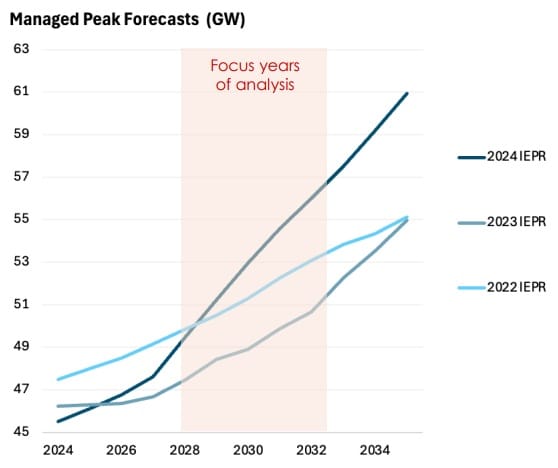
The California Public Utilities Commission last year identified a 6 gigawatt shortfall for 2032. The agency directed utilities and other load-serving entities to boost supplies to fill the gap. Consultant Energy and Environmental Economics recently identified multi-gigawatt deficiencies in both the Pacific Northwest and Desert Southwest. NV Energy and PacifiCorp, some of the largest utilities in the West, flagged shortages in recent regulatory filings.
While the CPUC has acted to shore up supplies, its analysis still assumes California can rely heavily on neighbors who aren’t going to have as much power to spare during heat waves.
It’s a problem that has precedent. California planned for more imports than it got in August 2020, when energy shortfalls drove rolling blackouts, and again during the near-blackouts of September 2022. The state has built a huge battery storage fleet since then, but still is planning on 4 to 10 GW of imports that might not be there the next time they’re needed.
“The Northwest region has shifted from a position of surplus electricity towards not having enough power at critical times,” Pacific Northwest Utilities Conference Committee Executive Director Crystal Ball said in a press release. “The gap between supply and demand widens over the 10-year forecast.”
That’s why people like Nick Pappas, an energy industry consultant working on reliability planning in California and the broader west (including for ACP-California), are worried.
“We’re in a moment where the reliability alarm bells are ringing across the West,” Pappas said. “There’s a growing consensus that deficiencies are looming, and we need to act fast on solutions.”
Need for speed
So what needs to happen? Two big things.
First, agencies and utilities need to work together to understand the scale of the problem and adjust plans based on the new reality.
The CPUC, as mentioned above, took an important step last year (in response to an ACP-CA proposal) by issuing its 6 GW reliability order. Western energy markets launching in the next few years, along with new resource-counting frameworks for the West, will help, but their success will depend on planning, procurement and construction that should be happening now.
The second piece is even more important. California (like the rest of the West) needs to build new power and new transmission faster and more affordably.
The state is building energy faster than ever before, but it’s getting harder, and transmission still needs to make big strides. The urgency here isn’t about meeting California’s climate goals. It’s about meeting rising demand at the least cost without more blackouts.
Lazard, a respected investment bank, publishes an annual report comparing energy costs by source. The most recent report, from June 2025, shows utility-scale solar and wind are cheaper than combined-cycle natural gas on a per-unit basis over projects’ operating lives, and that solar-plus-storage installations are competitive with combined-cycle gas. Renewables, increasingly, are also faster to build than gas plants, which is critical given the time crunch. They’re the cheapest and the fastest energy resources California and the West can build right now.
The biggest impediments to California meeting rising demand with renewables are the state’s own policies, procedures and bureaucratic delays. Some of those impediments are common among Western states, while others, such as those related to CEQA and the California Endangered Species Act, are unique to California.
This newsletter has covered a number of potential solutions, from CEQA and CESA and Williamson Act reforms to the pressing need to address widespread utility delays connecting new clean energy projects to the grid. Building new transmission faster is absolutely crucial.
The slow-motion nature of these grid challenges makes it hard to address them with the urgency that’s required. But once a crisis arrives it still takes a long time to address and it’s a lot more expensive. Better to heed the grid nerds now than see California come up short on energy later.
What’s happening
BACA qualifies
The Building an Affordable California Act, a CEQA reform ballot initiative, has officially qualified for the November ballot.
The CalChamber-led initiative includes helpful reforms for clean energy projects in addition to its provisions on housing, water and other infrastructure. The reforms include setting enforceable timelines for public agencies to complete environmental reviews and courts to review legal challenges, eliminating requirements for developers to evaluate an unlimited number of project alternatives, and establishing objective standards of review for projects.
Grid delays bill hearing
AB 2493, which addresses widespread utility delays upgrading equipment that’s needed to connect new clean energy projects to the grid, is scheduled for a hearing in the Senate Energy, Utilities and Communications Committee on Tuesday. The bill is co-sponsored by ACP-CA and the Union of Concerned Scientists.
SunZia online
The largest clean energy project in U.S. history is fully operational, developer Pattern Energy announced last week.
The SunZia project includes a 3,650 MW-wind farm in New Mexico and a 550-mile transmission line to deliver the energy to California and Arizona. It took 20 years, reflecting how hard it is to build critical energy infrastructure, but it’s a great milestone and a big boost to California’s evening grid.