California’s hot-rock potential

Geothermal is the Zendaya of clean energy. It’s buzzy, loved by almost everyone, and it’s as inescapable to followers of energy news as the actress with roles in Spider-Man, The Drama and The Odyssey is to pop culture consumers.
They even both got their starts in Northern California: Zendaya in Oakland and commercial-scale geothermal 70 miles north, in The Geysers complex south of Clearlake. Now geothermal is auditioning for a big part in California’s energy mix.
It’s got a lot going for it. Geothermal developers are reporting technological and commercial milestones on a near- weekly basis. Fervo Energy completed the largest IPO for a clean energy company ever last month, topping out at a valuation over $10 billion. Last week the U.S. House approved a geothermal permitting package in a rare bipartisan vote. And geothermal remains eligible for money-saving federal tax credits that the One Big Beautiful Bill Act is eliminating for wind and solar power.
California has signaled interest in a bigger role for the emission-free technology on its grid, but has yet to fully commit. More on that later. But first:
Why the hype, why now, and why here?
Geothermal energy has been around for decades, but it’s surging now for three main reasons: Drilling technology has advanced; the technology to turn underground heat into electricity has advanced; and states like California are seeking “clean firm” resources that deliver emissions-free electricity 24/7, complementing wind and solar power.
Early conventional geothermal developments like The Geysers work by piping steam from underground reservoirs to turbines on the surface that convert heat to energy. That technology only works in specific places with reservoirs of hot water underground.
Next-generation technologies can capture subsurface heat in places without those reservoirs, greatly expanding the territory where geothermal can work. The tech is propelling projections that subsurface heat could produce eye-popping amounts of power in the West (Princeton puts it at some 100 gigawatts.)
The resource is so promising out here because of the action of our local tectonic plates.
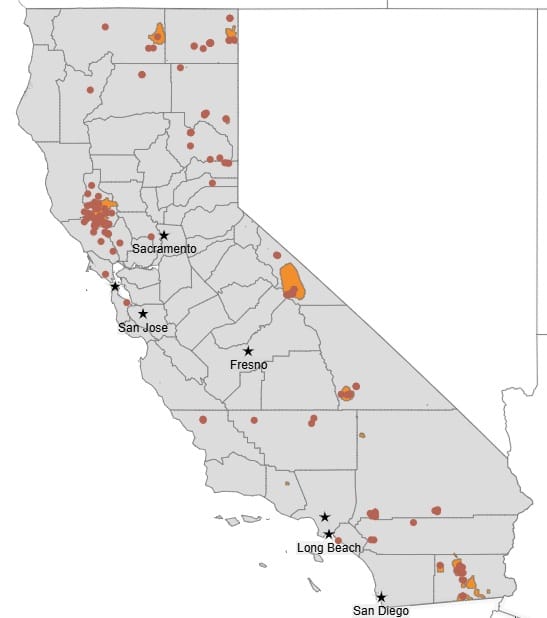
California is perched on the “Ring of Fire,” a chain of volcanic, earthquake-prone areas wrapped around the Pacific ocean. The grinding of tectonic plates beneath California has left a string of hotspots from Pinnacles National Park through the Berkeley Hills and up to Mt. Shasta. Other accessible heat pockets lie beneath thin, spreading plates under Nevada, Utah and New Mexico. The Salton Sea region has yet more potential.
Above-ground, California policies are helping to drive development. A 2021 California Public Utilities Commission order “catalyzed demand” for geothermal by requiring utilities and other load-serving entities to secure 1 gigawatt of clean firm power — enough to power roughly 1 million California homes. Fervo, which has advanced-stage projects in Utah and Nevada, has since signed full-fledged power purchase agreements with Southern California Edison, California community choice aggregators and Google.
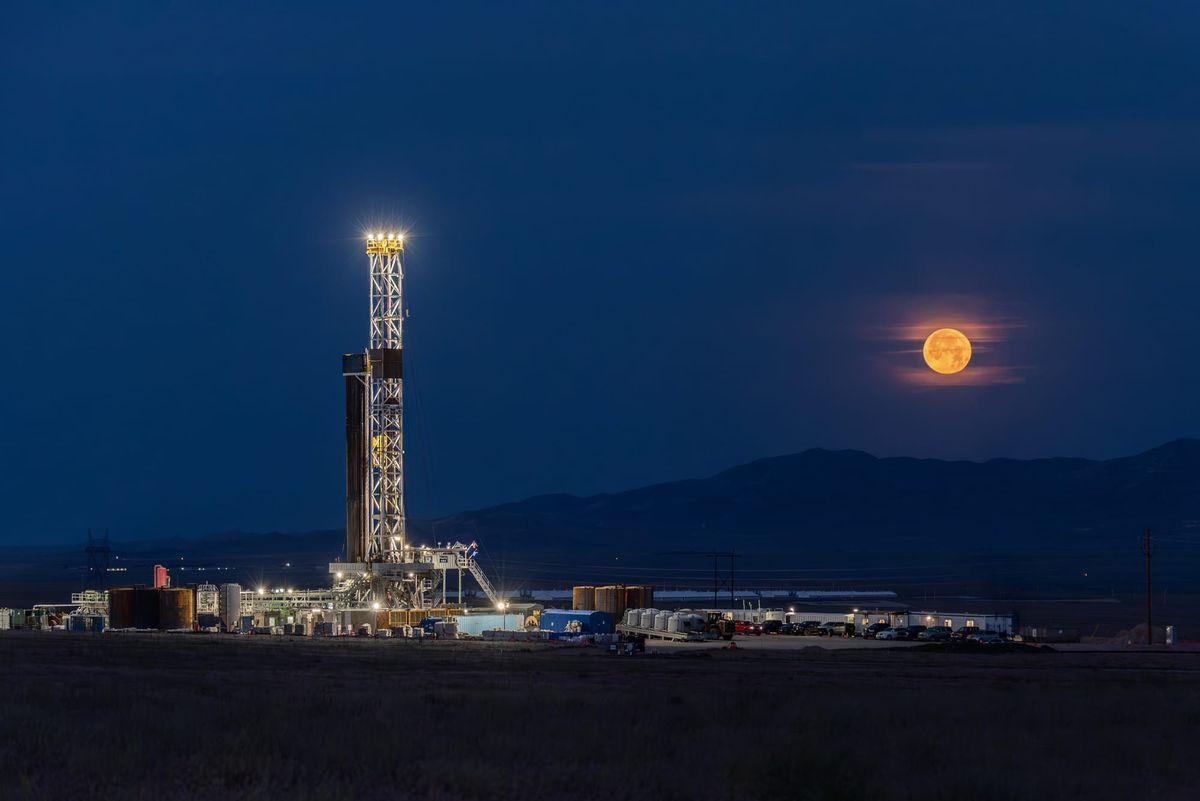
Fervo operates what are called enhanced geothermal systems. The company drills deep down into the ground, then drills horizontally, fracturing the rock so it can accommodate liquid. The company pumps degraded, non-potable water into the fractures, where it heats up before being pumped back to the surface to spin turbines and generate electricity. Then all of the water is pumped back into the wells and run through the cycle again.
The company is already delivering power to the grid. It expects to start supplying its California buyers this year and to be delivering 500 megawatts by 2028. The company also has lease positions in California.
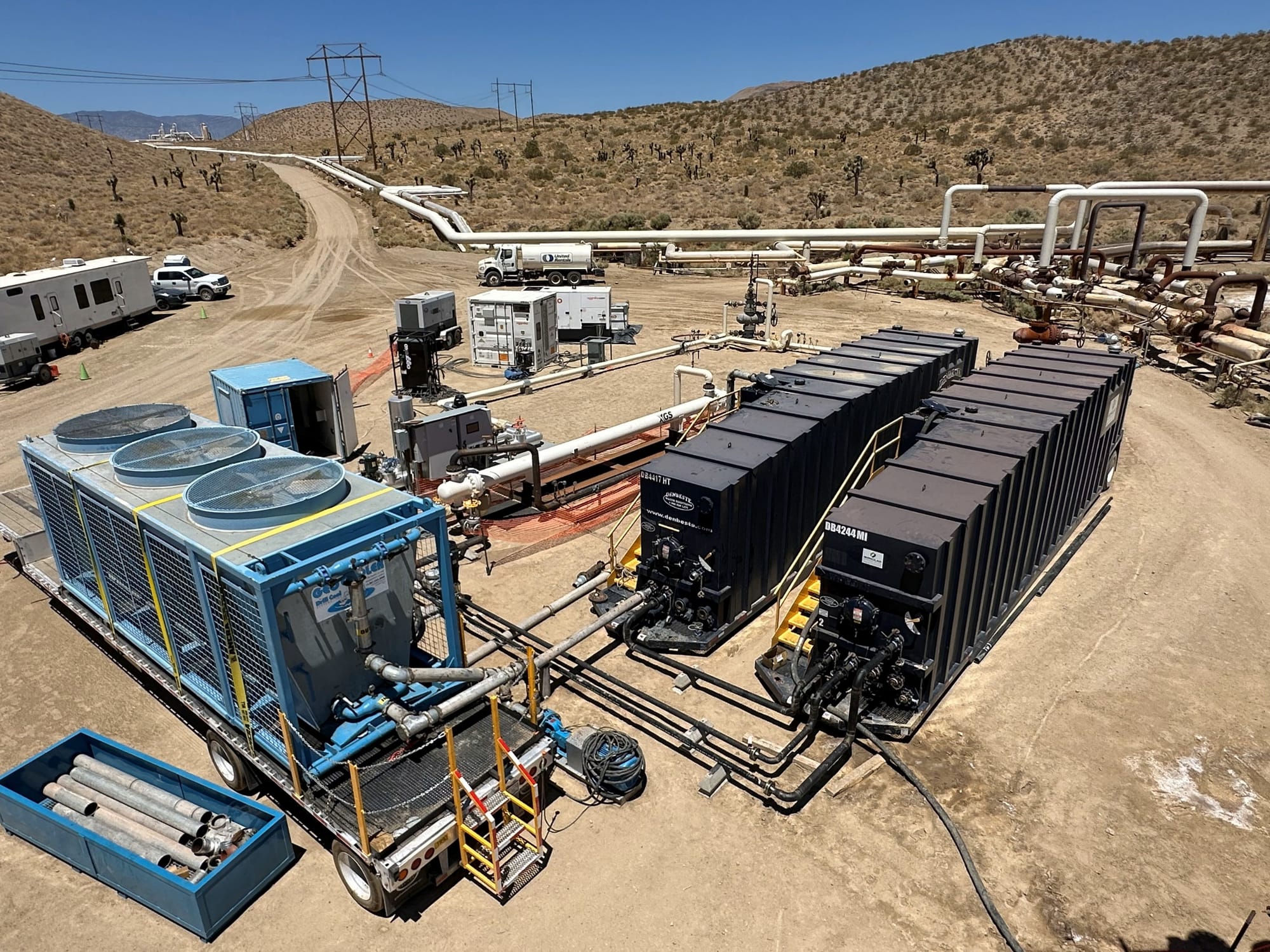
Other developers use a variety of similar-but-different technologies. XGS Energy, which in April announced a 115 MW agreement with California Community Power and has advanced projects in New Mexico, uses tech that circulates water inside closed tubes through hot rocks.
CPUC plans call for adding 5 gigawatts of geothermal to the state’s energy mix by 2045, with nearer-term requirements based on demand signals. It’s arguably the farthest-along non-fossil alternative to natural gas, which still provides roughly 40 percent of California’s electricity. But for geothermal to serve that role, the industry needs to grow and realize the cost savings that come with scale. California needs more transmission to import it and it needs faster, cheaper permitting and exploration to develop it in-state.
Fervo’s Southern Utah project, Cape Station, is already permitted to ramp up from 500 MW to 2 GW. California doesn’t have enough transmission to import more than it’s already contracted for, but there is a proposal on CAISO’s desk for a line that would do so. If California doesn’t act, massive data center proposals and demand from other states could gobble up geothermal supplies, knocking California out of the game.
Then there’s in-state development. XGS completed the first commercial-scale demonstration of a water-independent geothermal system last fall in the western Mojave Desert at the Coso Geothermal plant.
But the in-state hurdles are also daunting, starting with permitting. Companies start by drilling exploratory wells that can cost up to $20 million. Those wells are subject to CEQA, which can add years of process and millions more dollars to project costs before companies even know if the area is developable. If it is, companies face more permitting and more CEQA for additional wells.
Gov. Gavin Newsom last year signed AB 531, opening up the California Energy Commission’s streamlined permitting pathway under AB 205 to geothermal developers. Newsom vetoed another proposal in AB 527 that would have exempted exploratory wells from CEQA.
Additional assists from the state on permitting are needed, and California could help address the steep initial costs of exploratory drilling in other ways. The Clean Air Task Force has suggested taking cues from a Utah model in which the Department of Energy drilled exploratory wells and then made the data public, triggering billions in private investment.
Given the daunting growth in energy demand California faces, and absent other advanced-stage technologies that can be deployed in time, the state will need both in-state and out-of-state geothermal to maintain a reliable grid without resorting to more gas.
So while it may never star in blockbusters like Dune, Challengers or another Spider-Man, geothermal would be a dependable addition to the cast of California’s energy story.
Batteries, too
A battery storage project in Kern County suggests lithium-ion batteries might be able to pull more weight on the grid.
The project, which developer Rev Renewables dubbed Tumbleweed, is engineered to discharge electricity into the grid over eight hours, twice the standard four-hour duration for lithium-ion batteries, according to a writeup in Canary.
If feasible on a larger scale, eight-hour lithium-ion batteries could help solve the same problem as geothermal — keeping the power flowing when the sun isn’t shining, the wind isn’t blowing, and California’s four-hour battery storage fleet is depleted.
The project came about in response to the same 2021 CPUC procurement order, mentioned above, that generated the geothermal contracts, long-duration storage contracts, and 9.5 GW of other clean procurement. Without those “anchor contracts” that were signed in response to the procurement order, the eight-hour configuration wouldn’t pencil out, Rev’s Cody Hill told Canary.
But if lithium-ion batteries keep getting cheaper and more widely available, they could play a larger role on the grid. It should be noted, though, that batteries need to be charged. California is charging them with lots of cheap solar power now, but resource planners are forecasting charging shortages around the corner and part of the value of technologies like geothermal and offshore wind is their ability to generate — not just store and discharge — power after hours.
CAISO’s cheap power
CAISO’s wholesale electricity prices were the lowest in the country for the year ending in March, according to new EIA data.
The data reflects the market power of renewables, which tend to beat out natural gas on price.
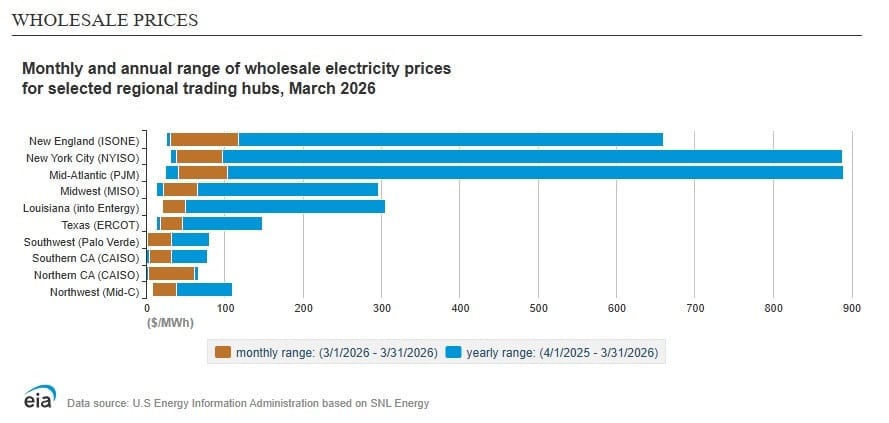
More natural gas-dependent markets, primarily in the Northeast, experienced larger price spikes, the data show.
Wholesale market prices don’t align with electricity rates, and California has some of the nation’s highest electricity rates. That’s largely because of wildfire costs, along with transmission and distribution spending and rooftop solar subsidies, according to the CPUC’s Public Advocates Office.
And, as we’ve written, most wildfire spending doesn’t belong in electric bills.
Have a drink on ACP-CA
If you’ve made it this far, you deserve a drink. Join us Tuesday, June 16 at Ella for a reception following ACP-CA’s lobby day. The reception runs from 5 p.m. to 7 p.m. Hope to see you there.