A state agency’s blunt warning on wildfire spending


If not now, when
Sacramento’s report of the year dropped last week, and it’s a doozy.
The California Earthquake Authority’s 128-page examination of wildfire spending, ordered up in last year’s Senate Bill 254, delivers an unusually candid assessment of what climate change is costing anyone who uses electricity or insures property in California — that is, nearly everyone.
It’s so candid it reminded me of a quote attributed to Barack Obama after his first national security briefing in 2008.
“It's good that there are bars on the windows here because if there weren't, I might be jumping out.”
The report emphasizes the connections among California’s brewing crises related to the costs of electricity, housing and insurance. Recent patchwork solutions (Wildfire Fund, Sustainable Insurance Strategy), while critical, aren’t enough. Things will only get worse, and there’s no clear point at which they’ll stop getting worse, if the people in power don’t make fundamental changes, the report warns, ominously.
“The status quo is not working,” it says. “Not for consumers, who are paying among the highest energy rates in the country; not for the private insurance market, which is retreating rapidly from making property insurance readily accessible in high-risk areas; and not for survivors, who are often underinsured, and in some cases uninsured, and thus lack access to timely, certain and adequate resources to recover.”
What it means for clean energy
This is bigger than clean energy, but it bears on clean energy because clean energy is what California is building to meet growing electricity demand and to achieve its climate goals. That’s the slice we’ll focus on in this newsletter.
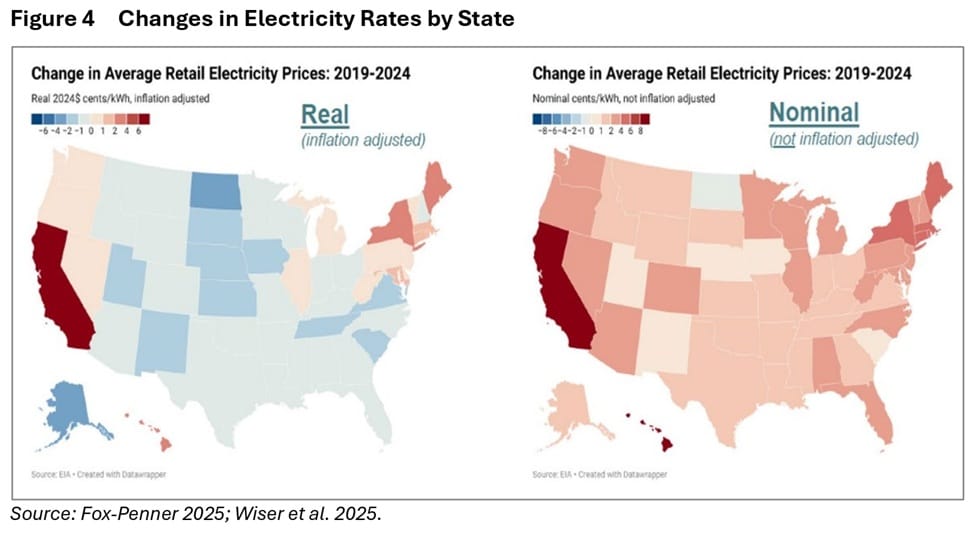
Clean power is the cheapest power you can build today, but its affordability benefits are obscured in California by electricity rates two to three times the national average. Those rates got that way largely because of expenses that don’t belong in electric bills, including wildfire prevention and response.
By removing those costs from electric bills, California can deliver relief to ratepayers and unlock clean power’s affordability, reliability and climate benefits.
The mountaintop of that quest is inverse condemnation, a legal standard in California that — unlike any other state in the West — makes utilities financially responsible for any damages caused by their equipment, even if the equipment is maintained perfectly.
Utility equipment sparks only about 6% of California wildfires, but, as the report puts it, “the conditions that determine whether an ignition becomes a catastrophe — accumulated fuels, community vulnerability, and building stock — lie largely outside the utilities’ direct control and outside of the purview of utility mitigation investments.”
The utility equipment that sparked some of California’s worst wildfires was not perfectly maintained (see, the book about it), but the report notes the huge strides IOUs have made since the effects of climate change became so pronounced. Those effects — lengthening droughts, higher temps, more volatile precipitation — combined with state and federal forest management practices that allowed dry fuel to accumulate, grew ignitions to catastrophes.
Consider the 2025 Eaton Fire that destroyed most of the Los Angeles suburb of Altadena. While it’s still under investigation, preliminary indications suggest it was started by an idle transmission line owned by Southern California Edison.
The Eaton Fire was one of about 14 that ignited during a “single extreme, climate-induced weather event” in which Santa Ana winds exceeding 100 miles per hour buffeted swaths of Southern California that had seen hardly any rain in nine months. Fires raced through “densely built, sparsely mitigated communities,” killing dozens of people and displacing tens of thousands. The Eaton Fire alone caused insured losses of more than $15 billion, per the report.
Insufficient funds
The Legislature and Gov. Gavin Newsom created the state Wildfire Fund in 2019. Combined with other reforms in AB 1054, it was designed to keep the IOUs solvent following PG&E’s bankruptcy the same year. The $21 billion fund was meant to cover multiple wildfires, but it might not even be enough for the Eaton Fire. SB 254 added a Continuation Account with $18 billion more. But the report warns these funds aren’t sufficient responses to a world that’s being fundamentally reordered by climate change.
As it stands, the IOUs’ customers pay for both the expenses related to past wildfires (so long as utilities are deemed to have prudently managed their equipment) and for investments aimed at preventing future ignitions. Those investments can be extraordinarily expensive.
As the California Public Utilities Commission said in its own SB 254 response in January, the current system "treats utilities as if they are solely responsible for damages from catastrophic wildfires and can fully mitigate the risks of those damages through reasonable diligence." They can’t, and their ratepayers can’t afford to keep paying to try.
All the billions at issue here can become numbing, but stick with me for a couple more. PG&E’s bankruptcy resolved about $25.5 billion in wildfire liabilities stemming from the Camp Fire and the Northern California wildfires of 2017-2018. From 2019 through 2024, the IOUs alone have spent more than $40 billion on wildfire mitigation, and they’re still going.
Wildfire-related charges now add about $41 per month to the average PG&E bill (19%). It’s $27 for SCE and $21 for SDG&E. The CPUC projects rates will keep rising by 6% to 7% per year through 2028, a trajectory the report says “creates direct tension with the state’s climate goals, diminishing the economic case for electrifying transportation, heating and industrial processes.”
High electric bills also make it more difficult to invest in the critical transmission and distribution system upgrades that are needed to keep California’s grid reliable and bring down long-term costs.
Finding the way forward
Both the CEA report and the CPUC report discuss potential solutions. They include reforming inverse condemnation; paying for wildfire mitigation from new sources such as the general fund or Cap-and-Invest proceeds; expanding the Wildfire Fund’s funding pool to include sources such as bonds, local governments, insurers, and additional utilities; and capping utilities’ liability for noneconomic and punitive damages in lawsuits.
None of that is easy, as Politico’s Camille von Kaenel noted in her writeup of the report last week.
Von Kaenel found that while there may be support for a state-backed insurance program or a temporary sales tax to cover some wildfire losses, there appears to be little appetite right now for the report’s big enchilada.
“For all the report’s discussion of overhauling inverse condemnation … there’s little sign anyone is ready to take that on directly,” von Kaenel wrote. “Weakening the standard would ease pressure on utilities but shift risk onto insurers, a tradeoff that cuts across powerful interests. [Assembly Utilities and Energy Chair Cottie] Petrie-Norris and [SB 254 author Sen. Josh] Becker both declined to stake out a position.”
Petrie-Norris was quoted saying, “If we make a bunch of changes, but we’re just shuffling the deck chairs on the Titanic, that doesn’t feel like a very productive use of our time or energy.”
That’s fair. But the CEA report’s main value is its spotlight on the icebergs ahead. It does contain nuggets of hope for diligent readers, including a mention of the state’s success stabilizing and restoring insurance, housing and mortgage markets following earthquakes in the 80s and 90s.
“The state rose to meet the challenge and address serious market disruptions that frequently follow from natural catastrophes,” said the report.
For the sake of California’s power grid, its clean energy transition and more, it has to do so again.
De-congesting the grid
The California Independent System Operator released its draft 2025-2026 transmission plan on April 7, and its theme is congestion.
As mentioned in the last edition of this newsletter, congestion happens when there’s not enough capacity in power lines, substations or other infrastructure to freely accommodate the flow of power from one place to another on the grid.
Congested lines make electricity more expensive and less reliable. CAISO’s projections — based on demand modeling from the California Energy Commission and supply projections from the CPUC — are starting to signal alarming levels of congestion on key transmission corridors in about a decade.
The new plan is focused on delivering relief. It calls for spending $7 billion over the next 10 years (up from last year’s approved $4.8b spend) on 38 projects. The plan includes upgrades to serve the San Joaquin Valley’s growing solar and storage hub, Southern California projects, and the Bay Area grid.
It also identifies the need for a new high-voltage line to expand capacity on Path 15, a notorious Central California corridor where CAISO has estimated congestion costs could reach $1.2 billion per year by 2035. The plan calls for more detailed studies on that one and anticipates proposing a project next year.
CAISO is holding a hearing on the draft plan today, and a board vote is scheduled for May.