Show love for transmission

Approving the transition
Remarkably, California has added enough clean energy to its grid in each of the last two years to meet the breakneck pace called for in its climate plans. Not so for transmission.
The middle child of California’s clean energy transition hasn’t received the same attention as clean power nor has it been pampered the way electric vehicles have. But energy planners can show transmission some love in a pending update to California’s climate roadmap.
The first edition of the roadmap, published in 2021 via SB 100, splashed cold water on everyone’s face by establishing the 7-gigawatts-a-year pace at which California must build clean energy to reach 100 percent of retail electricity sales by 2045. The state was averaging less than 2 gigawatts per year when the report came out, but managed to hit the target (owing largely to a battery storage boom) first in 2024 and again in 2025.
Transmission requires the same focus. There’s a shortage of capacity on the grid to connect all the new solar, storage, wind and geothermal power California needs to meet rising demand and its clean energy goals. That’s illustrated vividly in the California Independent System Operator’s grid interconnection “heatmap,” pictured below.
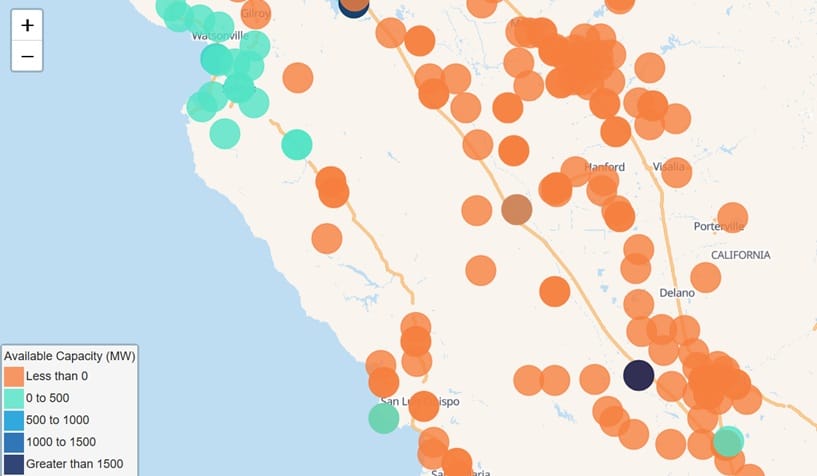
That lack of capacity means California’s grid is becoming congested, and congestion makes electricity more expensive and less reliable. We need a lot more power lines, substations and other infrastructure to ensure clean energy can flow to the places where people are powering more EVs, electric appliances, air conditioners, manufacturing facilities and data centers.
Major transmission projects regularly take 10 years or more to complete, and California needs dozens more to accommodate the 165 gigawatts of new clean power it’s projected to need by 2045 to meet rising demand and the state’s clean energy goals. And they need to be built affordably.
This year’s SB 100 report presents an opportunity to raise the profile of transmission, starting with a pace-of-transmission goal similar to the last report’s 7-GW-a-year clean energy goal.
That should start with faster approvals. We have a rough sense of what the pacing of transmission approvals should look like thanks to CAISO’s 20-year outlooks. Working with state energy agencies, CAISO published the first of these outlooks in 2022 and puts out a new one every two years. The outlooks, which are informational, complement the annual Transmission Planning Process (TPP), in which CAISO formally approves new transmission plans on a 10-year timetable.
The last two 20-year outlooks identified a need for 41 major transmission upgrades by 2045. So far, based on ACP-CA’s review, just four of the 41 have been fully approved. Two have switched to an alternative track, leaving 35 that CAISO still needs to approve. To be built by 2045, they all need to be approved by 2035 at the latest (given the 10-year timeline mentioned above).
That’s more than three major approvals per year for transmission projects that will connect clean energy to the grid — triple today’s rate.
The Newsom administration, CAISO, and the California Public Utilities Commission have made progress. The CPUC made important changes last year to a transmission review process that hadn’t been overhauled in 30 years, including relaxing a requirement for both CAISO and the CPUC to separately determine the need for the same proposed transmission project.
Newsom’s Tracking Energy Development Task Force, created in 2021, provided a pathway for project developers to bring specific issues to the administration’s attention and prioritize targeted solutions.
And CAISO, with the implementation of new practices for generators to interconnect to the grid, began to shift its planning from a reactive, first-come first-served paradigm to an approach that prioritizes shovel-ready generation projects near available transmission (though, as illustrated above, there’s not much).
Those efforts, in part, took their cue from the first SB 100 report. This year’s report can go further.
The CPUC today assesses where new solar, storage and other projects will be built based partly on the agency’s assessment of where there’s transmission capacity. That worked well when there was a lot of room in the system, but now that there isn’t, a new approach is needed.
The state should shift toward front-loading transmission development and aligning generation projects with transmission plans. That would help the big projects get started faster and it would create more certainty while spurring more competition among energy projects in the selected areas, driving down costs.
More aggressive transmission development would also cut congestion costs on existing power lines. This is an area where cost projections are rising alarmingly quickly: CAISO’s last transmission plan put congestion costs for a critical Central Valley line known as Path 15 at $390 million per year in 2034. This year’s estimate projects a cost of $1.2 billion in 2035, more than triple the last estimate. Path 26, a congested Southern California line, saw its congestion estimate rise more than half from 2034 to 2035, to $350 million.
The way to alleviate congestion costs is to build more transmission as quickly and cheaply as possible. To do that, the state should again look to the benefits of competition.
Competitive transmission development reduces costs by as much as 40%, the CPUC noted in a new concept paper prepared in response to Assemblymember Cottie Petrie-Norris’ AB 3264, a 2024 bill that ordered a report on ways to save money on transmission.
As we’ve discussed, competitive projects include cost-containment measures and penalties for delays. Those measures aren’t present in projects that are built by utilities without a competitive process. Yet only a small percentage of CAISO projects are competitively bid. The state should look at expanding the competitive portfolio to save money and build faster.
It’s not always easy to love transmission. It’s messy, complicated and can seem unapproachable. But it’s a part of the clean energy family, and the SB 100 report can give it the spotlight it deserves.
What's happening
EARTHQUAKE OF A REPORT: The release of the California Earthquake Authority’s highly anticipated report on California wildfire spending has been delayed from April 1 to April 7, according to the authority’s website.
The wide-ranging report, ordered in last year’s Senate Bill 254, is relevant for clean energy primarily because of its implications for electric bills. Costs related to past wildfires and spending to prevent future wildfires are top drivers of California’s high electricity rates, according to the CPUC’s Public Advocates Office, and high electric bills make it more difficult to make the clean energy investments that California’s goals call for.
Some lawmakers have called for shifting a portion of wildfire spending from electric bills to the general fund or other state sources as a way to alleviate some of the burden on lower-income ratepayers in particular. There’s also been talk of adjusting utilities’ liability for wildfires started by their equipment. The CPUC, in its take on SB 254 in January, offered good ideas for socializing wildfire cost burdens more equitably and changing the strict standard of liability for utilities.
The CEA is heading up the report because it administers the California Wildfire Fund. The fund was created in 2019 to help pay for claims related to utility-caused wildfires and to prevent utility bankruptcies. We’ll plan to give you our take on the report when it’s published.
TUNE IN: A packed agenda for the Utilities and Energy Committee hearing on April 8 includes AB 2493, the proposal from ACP-CA and the Union of Concerned Scientists to address interconnection delays.