Here comes the western spadefoot

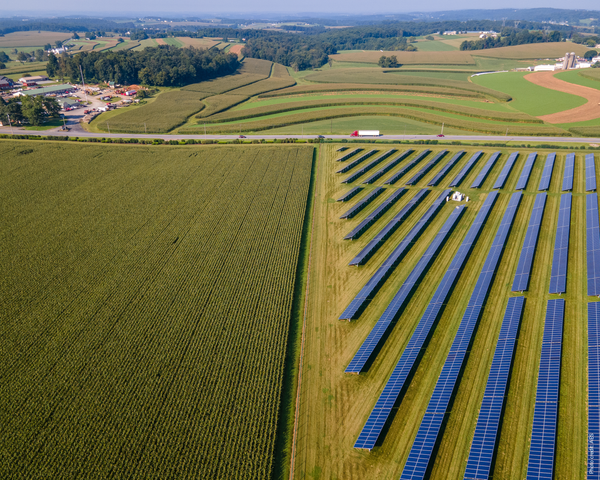
As we outlined here last month, California’s clean energy future runs through the San Joaquin Valley, where state agencies anticipate large-scale solar and storage projects existing in relative harmony alongside working agricultural land. But now there’s a new competitor on the scene.
The Department of Fish and Wildlife determined this month that the western spadefoot, a squat amphibian found in lowlands from Redding to Baja, may qualify for protection under the California Endangered Species Act. If the Fish and Game Commission agrees, it’s going to get harder and more expensive to build new solar where the state says it should go.
The Center for Biological Diversity petitioned to list the northern population of the toad-like species as threatened and the southern population as endangered last year. It was part of a surge in new filings that marked a sharp increase from prior years and is drawing new attention to California’s endangered species law, which comes with cumbersome and costly bureaucratic snags. California can streamline the law while still protecting the plants and animals that help make the state unique.
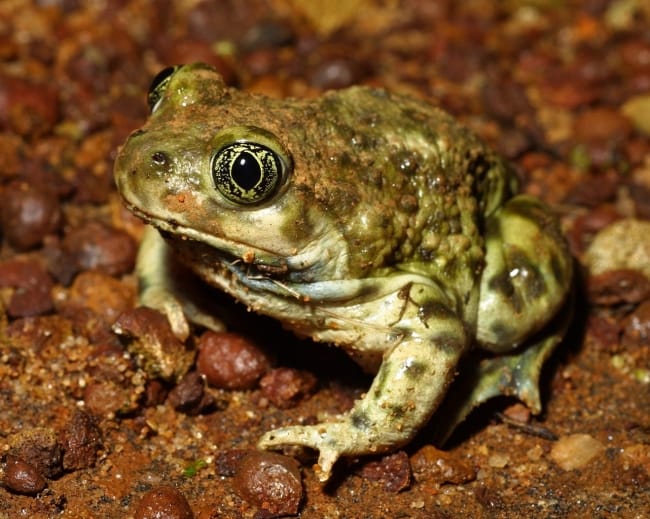
The western spadefoot is a toad-like species that gets its name from shovel-like growths on its back legs it uses for digging. Its habitat has declined over the years due to “agriculture, extractive development, and roads,” according to the Center for Biological Diversity’s petition.
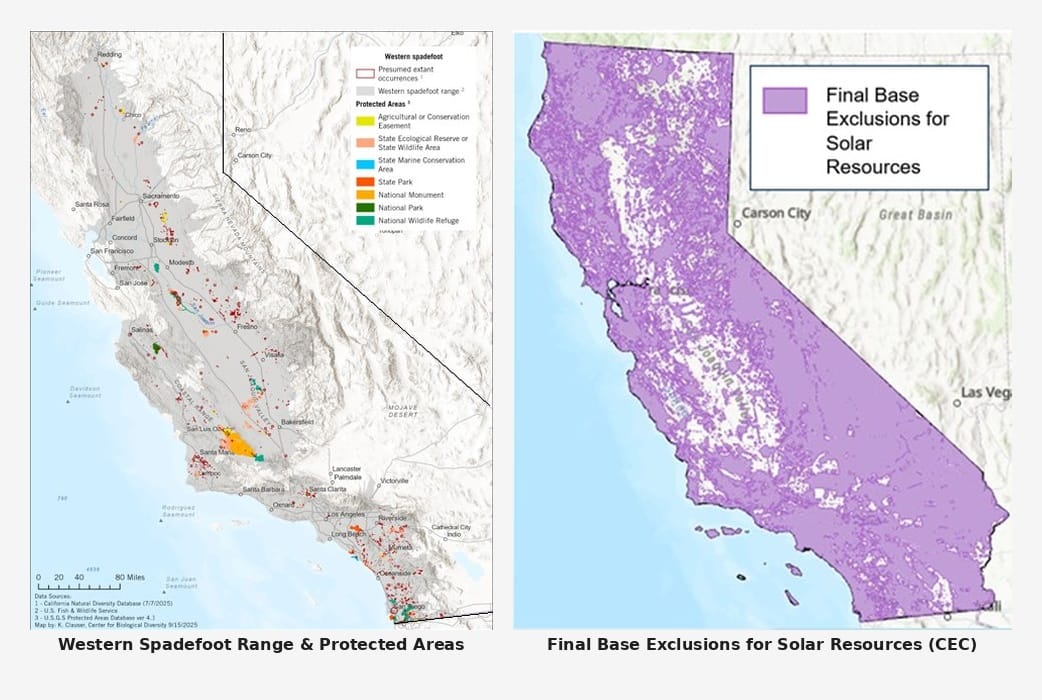
A map filed with the petition shows the spadefoot’s range blanketing the San Joaquin Valley from the coast to the Sierra foothills. It covers the same territory identified in California Energy Commission maps as the most suitable places for all the new clean energy California needs. Conservation groups and farmers have agreed since at least 2016 that formerly irrigated agricultural brownfields in that area present the least conflicts for California solar.
The spadefoot petition risks putting the species on a collision course with clean energy plans that, by the Public Utilities Commission’s latest calculations, call for 36 gigawatts of new solar and 18 gigawatts of storage by 2031.
Species listed under the California Endangered Species Act (which is separate from the federal Act) qualify for stringent protections. Developers who find them onsite must design projects to avoid impacts, relocate individuals they find, and hire biologists to monitor construction all day, every day, along with other steps. The most expensive requirement, usually, is preserving other pieces of land that are suitable habitat for the affected species, typically at a mitigation ratio of two or three acres or more for every acre of land used for development. Such land must be protected under a legal conservation easement and fully financially endowed so that it can be managed as habitat for the species in perpetuity.
Those requirements are expensive. For protected species such as the Mojave desert tortoise, the California tiger salamander and the Mohave ground squirrel, mitigation plans often add $10 million to $20 million — and sometimes much more — to the cost of California solar projects that produce in the range of 100 to 200 megawatts of power on anywhere from 400 to a few thousand acres. If those kinds of costs are tacked onto even a fraction of the 54 gigawatts of solar and storage in California’s plans due to the spadefoot, the tab will get big quickly. And because project costs are all baked into the price of electricity a project produces, those costs are ultimately paid by ratepayers.
You can argue it’s worth it. The protections preserved habitat for species such as the desert tortoise and the Mohave ground squirrel when most of California’s solar development was happening in the desert south.
But those are animals that have adapted to a specific area and a specific climate. Some of the newly petitioned species, such as the spadefoot and four different bumble bees, are found across such vast areas that the consequences are potentially much more significant for the price of electricity, housing, food, manufactured goods and anything else that requires development.
The mitigation requirements come on top of an ambitious push to preserve 30% of California lands under the 30x30 initiative. The state is already at 26%, including habitat preserved in land banks that are one way for solar developers to meet their requirements. It’s not a goal that should be paid for in electricity bills.
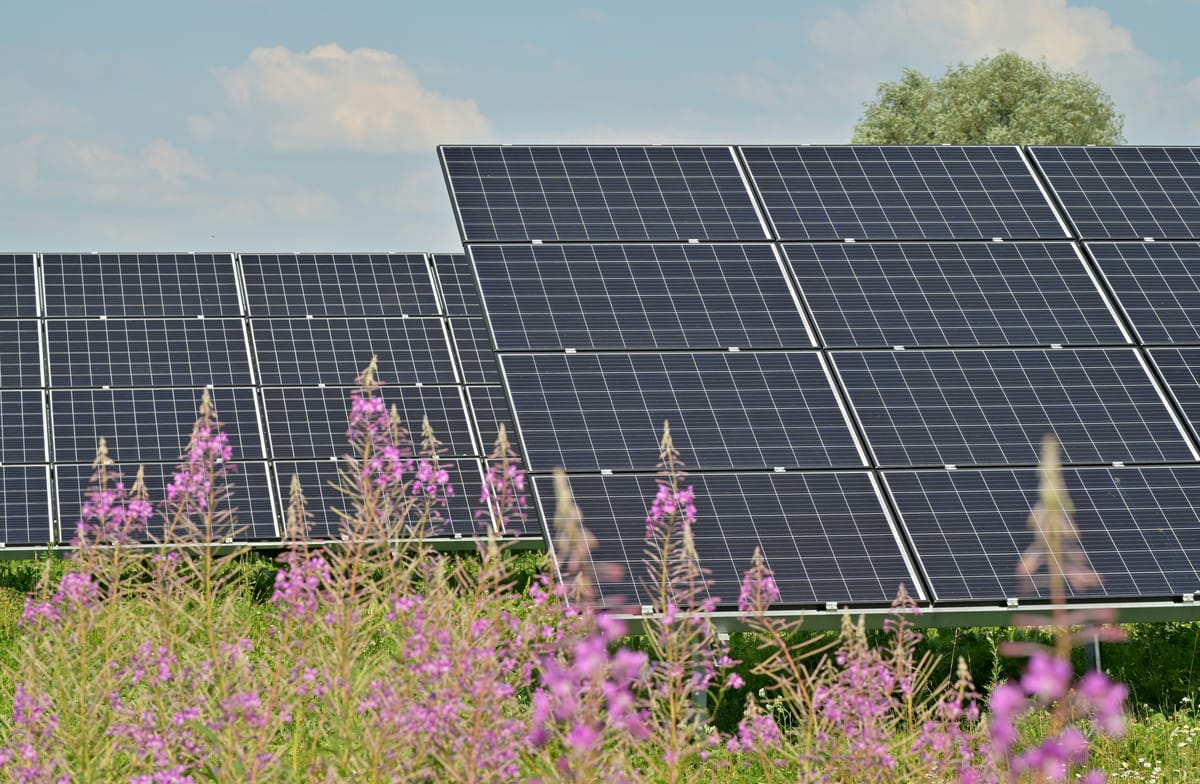
There’s growing evidence that some species thrive among solar panels (see, for example, the threecorner milkvetch), and site design can go a long way to accommodate species over decades of operation. Many of these species are highly adapted to anthropogenic habitats like agricultural landscapes. Solar projects can accommodate some of them better by eliminating chemical and mechanical uses common to agriculture.
So what’s to be done?
There’s a good place to start. California’s law, unlike the federal ESA, starts to protect species before they are officially listed. The state law kicks in once the Fish and Game Commission determines that protection may be warranted based on the petition — which in practice has been a low bar.
Maybe it’s worth waiting for the official listing, especially since the flood of new petitions could create a backlog in the listing process at the Department of Fish and Wildlife.
But here’s where the current process gets Kafkaesque.
For listed species, developers comply with the law by getting what are called incidental take permits for any endangered animals or plants on project sites. That’s the vehicle for CDFW to impose site design changes, site monitoring, the land purchases for mitigation, etc.
But when a species has been designated a candidate for listing — and is receiving the law’s full protections — developers enter a limbo phase. They can’t get an incidental take permit until the species is listed, and they can’t advance the project (i.e., get financing) without an incidental take permit. They just have to wait for CDFW to go through its process, and those delays add even more costs.
At the least, developers should be able to start the incidental take process once a species is designated as a candidate for listing. Assembly Bill 550 took a shot at that last year, but it was watered down in committees. It should be strengthened.
It’s useful to put this all in perspective. Climate change is the biggest threat to many species around the world, humans included. Widespread, rapid clean energy deployment is, to borrow a phrase from author and climate champion Bill McKibben, the one true counteroffensive to rising global temperatures. California is a global leader in the climate space, and to reach its goals with public buy-in, the state needs to build faster and build cheaper. It’s time to modernize the California Endangered Species Act to align with that effort.
What’s happening
Dig in: The Assembly Utilities and Energy Committee is holding a hearing today titled “Assessing Progress in Developing Clean Energy.”
The agenda and a committee backgrounder have been posted, previewing a hearing that will touch on delayed utility equipment upgrades, fragmented agency planning and the friction points in planning and permitting that are slowing deployment. Plus, of course, affordability, with a focus on expiring clean energy tax credits.
Temperature check: The CEC, CPUC and CARB are scheduled to preview tomorrow their latest plans for achieving the goals in SB 100, the landmark 2018 law that requires California to transition to 100 percent carbon-free electricity by 2045.
In a workshop scheduled from 9 a.m. to 4 p.m., the agencies will present draft electricity modeling results and an overview of the implementation challenges that lie ahead. The initial info will feed into the joint agency report that SB 100 requires the agencies make to the Legislature every four years.
The first SB 100 report, issued in 2021, set the stage for California’s energy transition by sketching out what it would take, year by year and sector by sector, for California to meet its climate goals. Since then there’s been a change in the White House, AI-driven electricity demand has exploded, and wildfire-related grid costs have come into clearer focus.
The second report, due in 2025, has been delayed. It will be interesting to see how detailed tomorrow’s assessments are and whether they call for any big shifts in which resources, technologies or strategies California plans to use to meet the law’s targets.
Trust the firefighters: American Clean Power recently posted an educational video that features firefighters talking about battery storage safety.
The 15-minute video is geared toward an audience of firefighters, first responders and people who live near storage sites, but it’s an informative watch for anyone who wants to know more about what goes into making storage sites safe and what the risks are from (rare) fires at the sites.